


Medina: A Spiritual Journey Between Religious Tranquility and Historical Landmarks in The City of Medina

On the authority of Abu Sa’id al-Khudri (may Allah be pleased with him), he said: The Messenger of Allah (peace be upon him) said: “Do not set out on a journey except to three mosques: the Sacred Mosque, the Al-Aqsa Mosque, and my mosque.”
Medina holds a special place in the hearts of Muslims; it is the city of the Messenger of Allah (peace be upon him), and within it lies his blessed mosque, to which journeys are made. It was the center from which our noble religion spread to every corner of the world. In its vicinity, visitors experience a sense of tranquility that fills their hearts, and a profound peace that flows through their veins, as they are near the beloved Prophet and stand where the noble companions once stood.
Each year, millions of visitors come to Medina, the majority seeking religious tourism. In this article, we will explore the most important historical, religious, and cultural sites that have shaped Medina’s landmarks, so you can plan your trip with awareness.
The Prophet’s Mosque: The Heart and Soul of Medina
Abu Huraira reported that the Prophet Muhammad said: “A prayer in this mosque of mine is better than a thousand prayers in any other mosque, except the Haram Mosque.”
In Islam, the Prophet’s Mosque ranks second in virtue and reward after the Haram Mosque. One prayer in the Prophet’s Mosque equals a thousand prayers elsewhere, as mentioned in the hadith. It is also one of the mosques to which the Prophet commanded Muslims to travel.
It was the second mosque built in Islam, and the first action the Prophet took upon his arrival in Medina, then called Yathrib. The Ansar competed to invite him to stay with them, but he instructed them to let his camel decide where his house and mosque would be. He said, “Let it go, for it is commanded.” The camel walked until it knelt at the land of two boys, who were using it to dry dates. The Prophet called the boys to buy the land, and even though they offered it to him as a gift, he insisted on purchasing it. The Prophet himself placed the first stone to build the mosque, and the companions worked with him, reciting, “O Allah, the life is the life of the Hereafter, so have mercy on the Ansar and the Muhajirun.” This act illustrated solidarity among the Muslims from day one.
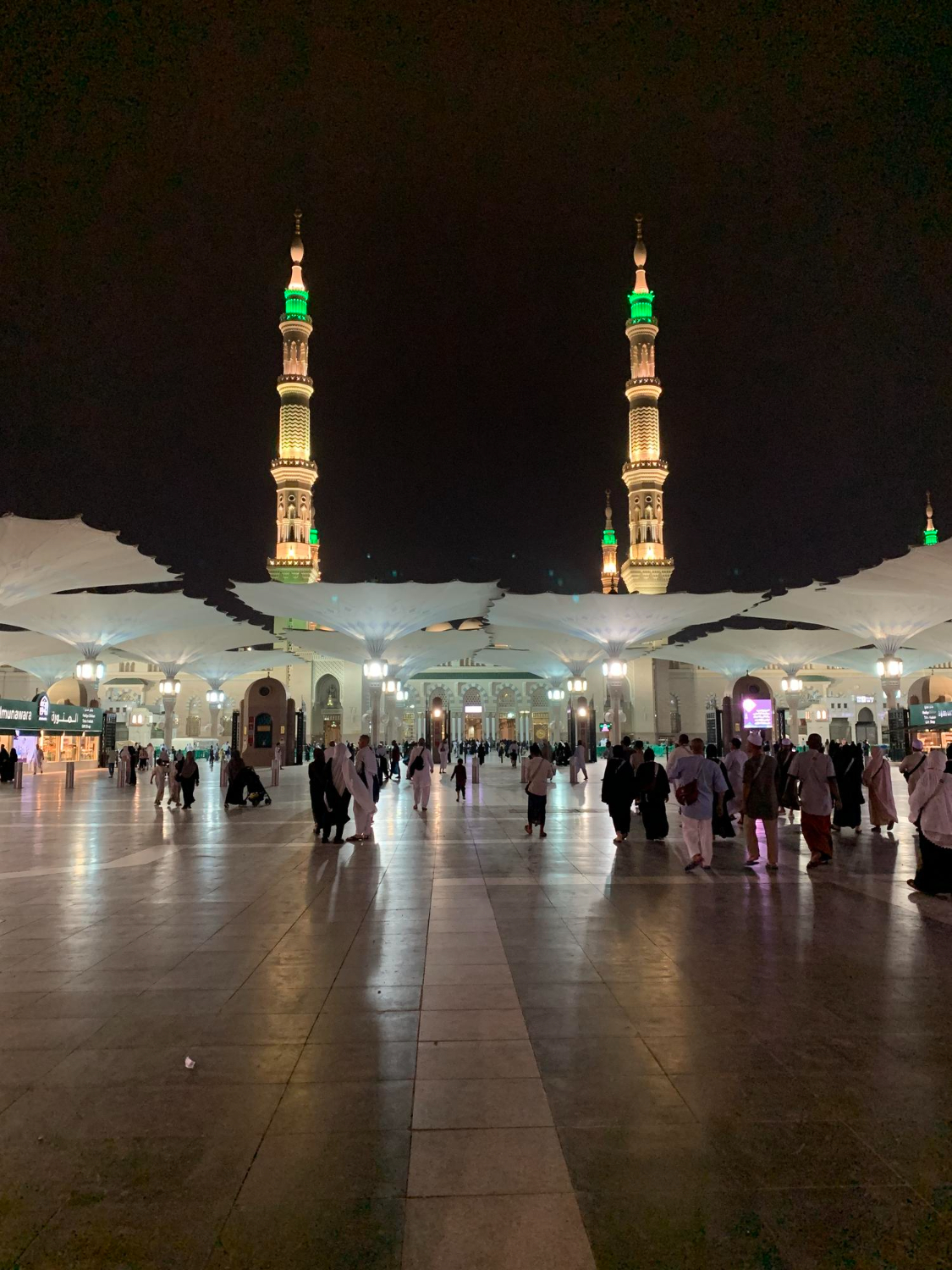
Today, the Kingdom of Saudi Arabia places great emphasis on the Prophet’s Mosque. It was the first building to receive electricity in 1909, and subsequent expansions have been carried out to accommodate all visitors. The mosque now includes the Noble Rawdah, the Prophet’s chamber containing his grave alongside his companions Abu Bakr and Umar, multiple prayer niches including the Prophet’s, Uthman’s, and Suleiman’s, the Prophet’s pulpit, the columns, and several shaded courtyards with smart umbrellas to protect worshippers from the sun and rain. It also features twenty-seven movable domes, multiple doors, ten towering minarets, a library with thousands of books and historical manuscripts, as well as services like Zamzam water dispensers, underground facilities such as restrooms and parking, to make it easier for worshippers to access the mosque for prayers.
Historical Landmarks Telling the Story of Islam
In addition to the Prophet’s Mosque, Medina is home to numerous religious and historical landmarks that tell the story of Islam’s spread. These landmarks still stand today as a living testament to the great religion that emerged from this point. Among these landmarks are:
Mount Uhud and the Mosque of the Master of Martyrs
Mount Uhud is a mountain range surrounding Medina, extending over seven kilometers. It witnessed the historic Battle of Uhud, which took place in the third year of Hijrah in the month of Shawwal. In this battle, the Muslims faced off against the polytheists. The Prophet Muhammad (PBUH) mentioned that “Uhud is a mountain that loves us and we love it.” In this battle, the Muslims suffered significant losses, and several prominent companions were martyred, including Hamza ibn Abdul Muttalib, the Prophet’s uncle; Hanthala ibn Abu Amir (the “Washing of the Angels”); Mus’ab ibn Umayr; Abdullah ibn Amr ibn Haram; Amr ibn al-Jamuh; and others. The martyrs were buried in the Martyrs’ Cemetery near the battle site, and Muslims continue to visit them to this day to remember the events of the battle, feel the difficulties endured by the Prophet and his companions in spreading the message, and to pray for them. In 2017, the Mosque of the Master of Martyrs, Hamza ibn Abdul Muttalib, was built at the site. It is a large mosque and one of the city’s prominent landmarks, capable of accommodating 15 worshippers.
Quba Mosque
This is the first mosque ever built in Islam, constructed by the Prophet Muhammad (PBUH) during his migration when he stopped at the homes of the Banu Amr ibn Awf before arriving in Medina. The Prophet (PBUH) personally laid the foundation stone of the mosque and would visit it occasionally to pray there, even after the construction of the Prophet’s Mosque. It is considered the best mosque in Islam after the three sacred mosques, and praying in it is equivalent to performing Umrah for those who purify themselves at home and visit it for worship. Allah has testified to its significance as a mosque built upon piety, as mentioned in the Quran: {A mosque founded upon piety from the first day is more worthy that you stand therein for prayer.} (At-Tawbah 9:108)
The Mosque of the Two Qiblahs
The Mosque of the Two Qiblahs is one of the most significant historical mosques in Medina, located northwest of the Prophet’s Mosque. It is famous for being the place where the revelation came, changing the direction of the Qiblah during the Dhuhr prayer. The Prophet (PBUH) prayed two rak’ahs facing Al-Aqsa Mosque, then turned and completed the prayer facing the Kaaba.
Baqi’ al-Gharqad
The Prophet Muhammad (PBUH) chose this site as the first step on the path to paradise for the companions. It is the place where more than ten thousand companions are buried, which is why it is called Jannat al-Baqi (The Garden of Baqi). Among those buried here are several of the Mothers of the Believers, the Prophet’s daughters, his son Ibrahim, and many companions, including the companion Uthman ibn Affan. This cemetery can be visited to pray for the deceased.
Popular Markets and the Cultural Experience of Medina
Medina is also famous for its many traditional markets that connect the depth of history with the present, taking visitors on a journey that transcends time. Before Islam, the city of Medina, then known as Yathrib, was an important commercial and agricultural center in the Arabian Peninsula, and it maintained this status even after the advent of Islam. As a result, the city is home to markets with deep historical roots, such as the 430-year-old Souq Al-Suwaika, the historic Souq Al-Munakhah, and Souq Bilal. These markets offer an authentic experience for purchasing dates, perfumes, and handcrafted products, providing visitors with a unique perspective of Medina from a fresh angle.
Taybah, the City that Unites Faith and History
Thus, Medina is a city that blends both religious and cultural tourism. The many mosques, historic cemeteries, popular markets, and battle sites offer visitors the opportunity to travel through time. Ultimately, the significance of Medina lies in its immense value in Islam, as the Prophet’s Mosque stands as a testament to the city’s revered place in the hearts of Muslims. Meanwhile, its historical landmarks, such as the Quba Mosque, the Mosque of the Two Qiblahs, Mount Uhud, and Baqi’ al-Gharqad, tell timeless stories of Islam and its early beginnings.
In this way, Taybah remains a destination where tranquility is renewed, a city that combines the sanctity of place with the depth of history, offering every visitor an unforgettable experience in the heart of the Islamic world.